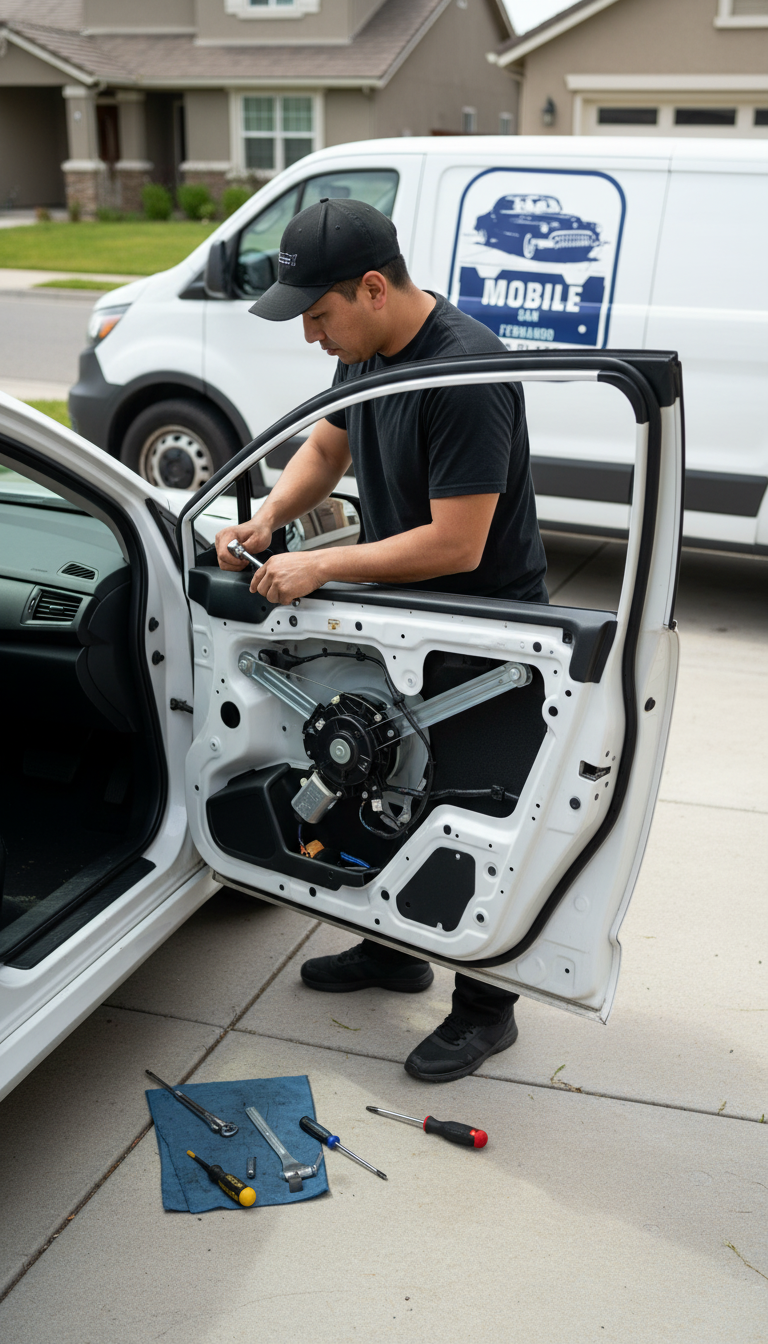
Get door window movement back to smooth, straight travel with precise regulator diagnosis, correct fit parts, and clear upfront estimates.
Window regulator repair corrects the door mechanism that raises and lowers the glass when the window sticks, moves slowly, stops halfway, tilts in the channel, drops into the door, or makes a grinding or clicking noise. Work focuses on the window regulator assembly, window motor, cable system, track, carrier, brackets, mounting points, and glass alignment to return stable movement and reliable closure.
Technicians at Mobile San Fernando Car Glass confirm the failure pattern by checking motor strain under load, cable travel and tension, track bind, carrier stability, mounting integrity, and glass seating at the top seal, then verify results with repeated full range cycling and final close testing.
Regulator failure often shows up as a window that will not move, moves unevenly, or will not stay positioned. Restore stable travel, correct alignment, and full close seal contact.
Commonly points to a failed window regulator assembly, a seized track path, or a motor that cannot move the mechanism under load. Inspection confirms whether the carrier, cable, or motor drive is holding the glass in place.
Slow travel or stopping halfway often comes from cable drag, pulley resistance, track bind, or motor strain under load. The fix targets the resistance point inside the regulator system, so the glass moves smoothly from bottom to full close.
A sudden drop can happen when the carrier plate loses grip, a bracket breaks, or a cable system releases tension. Secure retention and correct mounting points matter as much as restoring movement.
Tilted glass usually signals misalignment at the track, carrier, or guide channel, not a simple switch issue. Alignment correction keeps the glass straight and prevents repeat binding.
Grinding or clicking can indicate gear wear, cable spool issues, or pulley drag inside the regulator assembly. Noise under load is treated as a mechanical warning sign that needs diagnosis before the window stops completely.
A power window system relies on a regulator mechanism to guide the glass's travel and a motor to drive the movement. Most failures trace back to mechanical wear points, alignment loss, or motor strain.
The regulator assembly carries the glass and guides travel through a track and carrier system. Cable-driven, scissor-style, and gear-driven designs all fail in predictable wear zones.
A weak motor may move the window intermittently, slow the travel, or stop when resistance rises. Diagnosis checks motor output while also checking for mechanical drag that overloads the motor.
Frayed cables, worn pulleys, and damaged gears create drag, noise, and uneven travel. Correcting cable tension and restoring clean movement often requires replacement of the worn regulator assembly.
Track bind, loose mounting points, and bracket flex can tilt the glass and create stop points. Restoring stability keeps the carrier aligned and protects long term operation.
Even with a new regulator assembly, poor alignment can leave the glass crooked or short of full closure. Final alignment targets straight travel and seal contact at the top.
Accurate correction depends on identifying the failure pattern inside the regulator system. Recommendations stay focused on the regulator assembly, motor load, cable travel, and track alignment.
Alignment correction, mounting stabilization, and targeted motor correction may resolve the issue when the regulator structure remains intact. The decision comes from track condition, carrier stability, and noise under load.
Replacement is commonly recommended when cables are frayed, gears are worn, the carrier is damaged, or the mechanism binds repeatedly. A complete regulator assembly restores predictable travel.
Some vehicles use a regulator with the motor as one unit, while others allow motor replacement separately. Confirming the configuration avoids mismatched parts and repeated labor.
Glass must travel straight in the channel and sit fully at the top. Alignment checks focus on track position, carrier stability, and bracket integrity.
Work begins with symptom confirmation and ends with verified window operation. The finishing standard is smooth travel, straight glass movement, and full close seal contact.
The appointment starts by confirming how the window behaves and what noise occurs during movement. Details like slow travel, stop points, or tilt help isolate the failure location.
Inspection focuses on the window regulator assembly, window motor strain, cable routing, pulley movement, track condition, carrier stability, and mounting points. Electrical checks stay limited to confirming signal delivery when needed.
Correct regulator design and motor configuration are confirmed before installation. Matching the correct assembly prevents fit issues and restores proper window travel.
Repair or replacement is completed, then glass alignment is corrected in the channel and track. Brackets and mounting points are secured to prevent tilt and slipping.
Testing cycles the window through full travel multiple times, confirms straight movement, confirms full close seal contact, and checks for grinding, clicking, or rattling under load. Results are verified before closing out the job.
Proper correction restores reliable door window operation and stable glass positioning. Security and weather exposure risks drop once the window closes fully and holds position.
Smooth travel indicates the regulator assembly and track are moving without drag. The window motor should operate without strain during repeated cycles.
Straight travel keeps the glass seated correctly in the window channel. Correct alignment reduces binding and uneven stress on the carrier.
Full close seal contact helps prevent wind noise and water intrusion. The top seal and glass seating are verified during final testing.
A stable regulator assembly holds the glass up without drifting down. Carrier retention and bracket stability prevent the window from dropping into the door.
Pricing depends on regulator design, motor configuration, door access complexity, and parts availability. Accurate estimates require confirming the correct regulator assembly for the vehicle.
Different makes and models use different regulator designs, mounting points, and glass carriers. Correct configuration prevents return visits and restores proper travel.
Cable systems, scissor mechanisms, and gear-driven regulators have different failure points and part designs. The mechanism type affects parts selection and labor access.
A regulator with a motor assembly can change parts cost and installation time. A separate motor design can change the repair plan when motor output is the only fault.
Door panel access, mounting style, and fastener types affect labor time. Secure mounting points and stable brackets matter for long-term results.
Some regulator assemblies are readily available, while others require ordering by exact configuration. Scheduling improves once the correct assembly is confirmed.
Strong results come from correct diagnosis, correct parts fit, and verified window travel. Communication stays clear from symptom intake through final testing.
Appointments are scheduled around the window problem and vehicle availability. Mobile work reduces downtime when a window will not close.
Parts are selected by regulator design and motor configuration to match the door setup. Correct fit supports smooth travel and stable glass retention.
Get door window movement back to smooth, straight travel with precise regulator diagnosis, correct fit parts, and clear upfront estimates. Mobile scheduling fits your day.
Call +1 (818) 305-6256Monday to Sunday 7 am - 9 pm